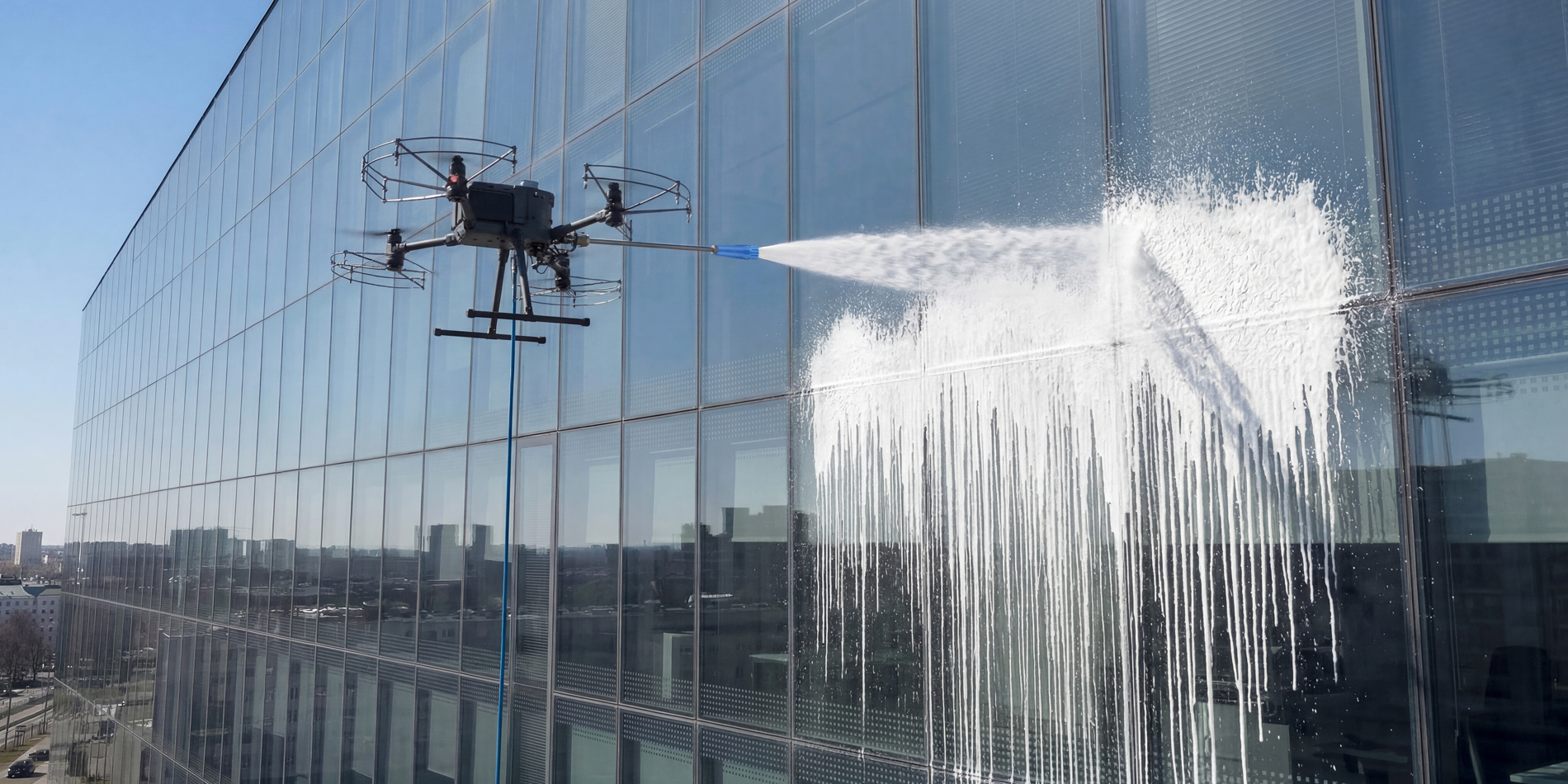
Professional drone-based cleaning combines high-pressure technology, foam pre-treatment and unmanned aerial systems (UAVs) to clean façades, roofs and photovoltaic arrays efficiently and safely – without scaffolding. For contractors, it is increasingly replacing cherry pickers and rope access, with a stronger safety profile and lower logistics costs.
The European cleaning industry is currently witnessing a paradigm shift. For decades, the challenges of maintaining large-scale commercial façades, intricate roofing, and sensitive photovoltaic arrays were defined by a struggle between height, safety, and logistical costs. Traditionally, reaching these surfaces required massive investments in scaffolding, cherry pickers, or specialized industrial rope access teams.
A new protagonist has emerged in the sky: the professional cleaning drone (UAV). This technology is no longer a futuristic concept but a highly efficient reality. As the industry faces a tightening labour market and an aging workforce less inclined to perform high-risk tasks at elevation, drone-based systems offer a sophisticated solution. By integrating advanced high-pressure washers with unmanned aerial systems, contractors can deliver precision results while keeping their teams safely on the ground.
In professional exterior cleaning, the “mechanics” of the cleaning process are often over-prioritised at the expense of the “chemistry”. When operating a drone, the ability to apply physical scrubbing is removed. Therefore, the strategic use of chemistry becomes the linchpin of the entire operation. It is nearly essential to begin any cleaning process – whether on glass, stone, or solar panels – with a high-quality, eco-friendly, and ideally biodegradable foam pre-treatment.
The technical advantage of foam over traditional liquid pre-spraying is twofold. First, foam provides significantly better contact time. Due to its stable structure, it adheres to vertical surfaces far longer than a liquid solution, which would simply run off. This extended dwell time allows the chemical agents to penetrate deep into organic growth, bird droppings, and industrial pollutants, effectively loosening the bond before the rinsing stage begins.
Second, foam serves as a vital visual indicator for the pilot. In high-altitude operations, it can be difficult to distinguish between wet and dry sections of a façade. The white foam provides a clear “map” of where the chemical has been applied. During the rinsing phase, the disappearance of the foam clearly marks the areas successfully treated with high pressure, ensuring a uniform result and preventing missed spots or unnecessary double-work.
Transporting cleaning agents to a drone operating at a height of 30 to 40 metres presents a significant engineering challenge. To protect the core of the system – the high-pressure pump – the industry standard has shifted toward downstream injection. In this setup, the chemical is metered into the water stream after it leaves the pump.
This requires specialised injectors with an extremely high back-pressure tolerance. Because the drone is connected via a long, lightweight, and relatively thin hose, the system must overcome substantial friction and gravitational resistance. At an altitude of 40 metres, the system naturally loses approximately 4 bar of pressure simply due to the height difference, not accounting for hose friction. A high-quality injector ensures that the chemical-water mixture is successfully transported over these distances without causing a pressure drop that would stall the foaming process or damage the ground-based equipment.
When it comes to the actual rinsing process, the choice of nozzle is critical for the stability of the UAV and the quality of the clean. Standard flat-jet nozzles often fail to deliver the necessary impact energy when the drone must maintain a safe distance from the building to avoid turbulence or physical contact.
Rotary nozzles (turbo nozzles) have emerged as the optimal solution for drone applications. When correctly calibrated, these nozzles produce relatively large water droplets. Unlike a fine mist, which is easily dispersed by wind or air resistance, these larger droplets possess greater inertia. This allows the water jet to maintain its integrity over a longer distance.
From a fluid dynamics perspective, these droplets create a localised vacuum in their wake, pulling smaller micro-droplets along with them. This “slipstream” effect allows the pilot to achieve an optimal compromise between high impact energy (mechanical cleaning force) and a broad cleaning path, significantly increasing the speed of area coverage without requiring the drone to hover dangerously close to the substrate.
Modern lightweight rotary nozzles, often constructed from glass-fibre-reinforced polymers, reduce the payload by nearly 200 grams compared to brass alternatives – a vital saving that extends flight times and improves battery efficiency.
Operating a cleaning drone is a multi-disciplinary task. To ensure maximum precision, the industry has adopted a split-control methodology. The pilot manages the aircraft’s position, pitch, and yaw using a professional hand-held remote control. However, managing the water flow through the same interface can be cumbersome and lead to delayed response times.
The professional standard involves a high-pressure foot switch located at the ground station. This allows the operator – or a secondary technician – to engage and disengage the water flow instantly. By separating flight control from hydraulic control, the team can manage the significant recoil forces (F_R) more effectively. When the high-pressure flow starts, the drone experiences a backward thrust; using a foot switch, the pilot can anticipate this movement with their hands solely focused on the flight sticks, ensuring a smooth, steady path along the façade.
The transition to drone cleaning is driven as much by the balance sheet as it is by technology. For facility managers, the traditional “hidden costs” of cleaning – scaffolding permits, sidewalk closures, and the rental of heavy machinery – can account for 50 % to 80 % of a project’s budget. Drones eliminate these overheads almost entirely.
One of the most innovative developments in the field is the shift in hose management. Traditionally, the hose trailed from the ground up to the drone, forcing the UAV to lift the entire weight of the water-filled line. Modern high-end setups now use top-down hose feeding or specialised lightweight hoses (such as Blupur systems). By supporting the hose from an elevated anchor point or using high-strength, low-weight materials, the weight load on the drone can be reduced by over 50 %. This not only increases agility but also serves as a secondary safety tether (Whip-Stop), capable of catching the drone in the event of a total motor failure.
As environmental regulations tighten and the demand for rapid, safe building maintenance grows, drone-based high-pressure cleaning is no longer a niche service – it is becoming the new standard. By combining the chemical efficiency of foam pre-treatment with the hydraulic power of rotary nozzles and the logistical agility of UAVs, the modern cleaning contractor can deliver a level of service that was previously impossible. Investing in these systems, alongside comprehensive hands-on training, ensures that today’s cleaning companies remain competitive, sustainable, and, above all, safe in an ever-evolving landscape.