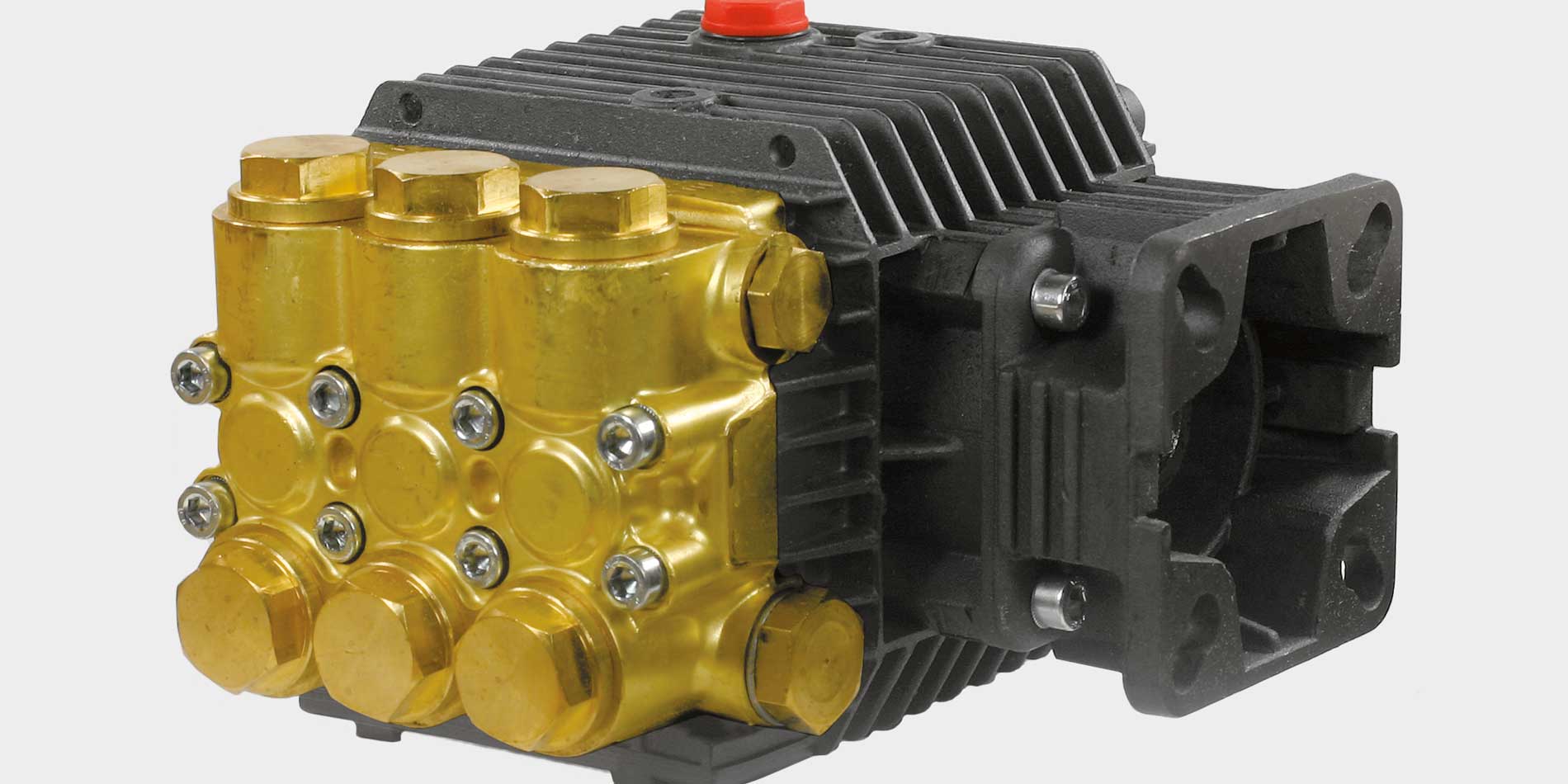
Whether direct drive, gearbox or belt drive, the choice of drive mechanism determines the lifespan, thermal management, footprint and serviceability of a high-pressure piston pump. At the centre of this decision is the relationship between the rotational speed of the power source, a combustion engine or an electric motor, and the optimal operating speed of the pump.
Every high-pressure pump has a speed range where wear, cavitation risk and heat generation stay within acceptable limits. Combustion engines, however, reach their maximum efficiency between 3,000 and 3,600 rpm, well above that target range. How a machine bridges this gap, not at all, through a gearbox, or through a belt, largely determines the technical quality and operating cost of the finished product.
Direct-drive configurations represent the most compact and cost-effective engineering approach. The pump is mounted directly onto the drive shaft of the motor, without any speed reduction in between.
Because the plunger mechanism is forced to cycle at the identical high speed as the engine, typically 3,000 to 3,600 rpm, the wear cycle of high- and low-pressure seals, packings and check valves accelerates significantly.
The rapid suction stroke minimizes the time window available for water to fill the pump chamber. This significantly elevates the risk of destructive cavitation, with corresponding follow-on damage to pistons, valves and seals.
Direct coupling creates a heat bridge from the hot engine block across the shaft into the pump crankcase. This degrades the lubricating properties of the pump oil and shortens the lifespan of the oil seals.
To mitigate these physical limitations, mechanical gearboxes reduce the input speed at typical ratios between 1:1.8 and 1:2.2, allowing the pump to operate within a highly durable window of 1,450 to 1,750 rpm.
Gearboxes offer an exceptionally compact and enclosed footprint that also fulfils aesthetic demands for a serialized, factory-engineered product. In comparison, however, they remain the most expensive component in initial procurement and do not absorb structural vibrations.
Belt-driven configurations use high-grade pulleys and V-belts or synchronous belts to achieve the same speed reduction while introducing complete mechanical isolation between engine and pump.
The inherent elasticity of a belt drive acts as a structural shock absorber: it dampens the torsional vibrations of combustion engines and mitigates the fluid dynamic shocks transmitted back through the pump when a trigger gun is suddenly closed. The physical separation also eliminates thermal transfer between engine and pump entirely, allowing the pump to run significantly cooler. In return, this configuration demands regular maintenance to monitor and adjust belt tension and requires a larger physical footprint.
| Criterion | Direct Drive | Gearbox | Belt Drive |
|---|---|---|---|
| Pump speed | Identical to engine speed (3,000-3,600 rpm) | Reduced to 1,450-1,750 rpm | Freely adjustable via pulley ratio |
| Footprint | Minimal | Compact, enclosed | Larger |
| Initial cost | Low | Highest | Medium |
| Vibration damping | None | None | High |
| Thermal isolation engine/pump | None, direct heat bridge | Partial | Complete |
| Maintenance | Low | Low | Regular belt tension checks |
| Cavitation risk | Elevated by short suction stroke | Reduced | Reduced |
What is the difference between direct drive and belt drive on high-pressure pumps?
With direct drive, the pump sits directly on the motor shaft and runs at its full speed. With belt drive, a pulley ratio reduces the speed and mechanically and thermally isolates the motor from the pump.
Why does direct drive increase cavitation risk?
Because the high engine speed forces a very short suction stroke. The pump chamber has less time to fill completely with water, which promotes cavitation.
Which drive type lasts the longest?
Both gearboxes and belt drives reduce pump speed into a more durable range. Belt drive additionally provides vibration damping and complete thermal isolation, at the cost of regular belt tension maintenance.
Direct drive suits compact, price-sensitive machines with shorter duty cycles. Gearboxes fit serialized products with high demands on footprint and appearance. Belt drive is the right choice when longevity, vibration damping and thermal isolation matter most, for example in professional continuous-duty applications. As a manufacturer of components for professional high-pressure cleaning technology, R+M / Suttner supports manufacturers and specialist dealers in selecting the right drive concept for their application.