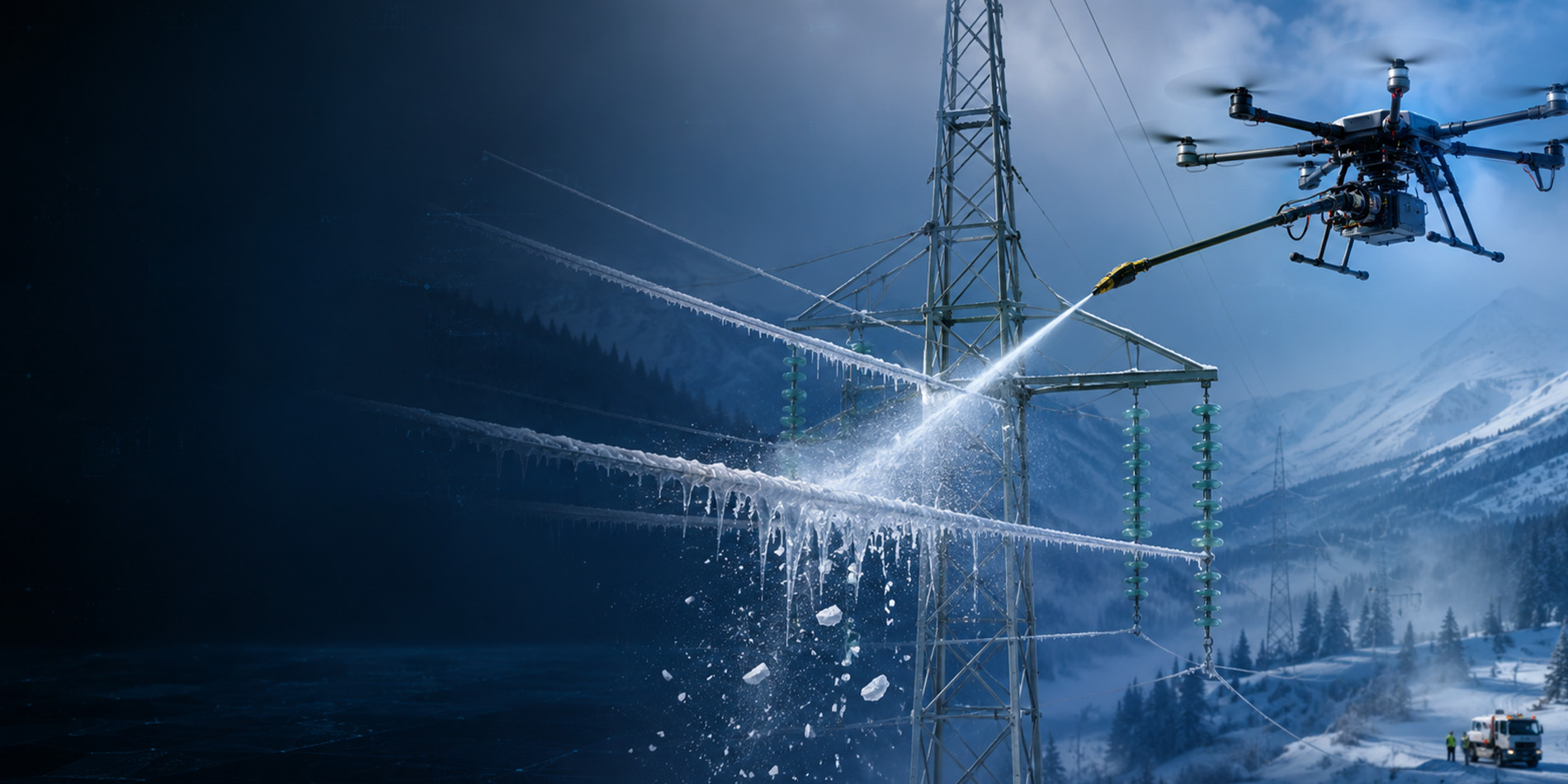
Drone-based de-icing of high-voltage power lines is a UAV-supported procedure that uses a long-range high-pressure point-jet nozzle to detach ice from energized conductors at a safe distance. The method enables live-line maintenance, removes the need for personnel to work at height, and protects towers, insulators and conductors from mechanical stress.
Drone-based de-icing is a grid-maintenance method in which an Unmanned Aerial Vehicle (UAV) serves as a flying platform for a specialised high-pressure point-jet nozzle. The objective is the controlled removal of ice and icicles from high-voltage lines before the additional weight leads to conductor galloping, cable breaks, or even the collapse of transmission towers.
Unlike conventional approaches, ice removal happens without physical contact and from a distance. The drone keeps a safe clearance from the high-voltage line and works well outside the critical arcing zone. This turns de-icing into a planned maintenance operation rather than a hazardous emergency intervention.
The core component of the system is a long-range high-pressure point-jet nozzle. These nozzles are engineered to maintain a highly coherent, concentrated water stream over significant distances of several metres. Unlike standard flat-jet nozzles, they retain almost all of their kinetic energy along that path.
The drone acts as a stabilised aerial platform that translates nozzle position precisely onto the conductor. Where required, the system can operate with anti-freeze additives or heated water, introducing an additional thermal component that weakens the bond between ice and conductor and supports mechanical detachment.
Instead of touching the conductor, ice is effectively “shot” off the line from a safe distance. The focused kinetic energy of the water jet creates localised mechanical stress and fractures at the point of impact, causing the ice shell to fragment and fall away in a controlled manner.
This point-load approach allows for surgical removal of ice buildup. The structural integrity of the cable remains fully preserved while the dangerous weight load is eliminated step by step, without sudden mass shedding.
Drone-based de-icing replaces three classical, far riskier procedures: manned helicopter operations, manual ice removal by personnel in baskets, and mechanical vibration of the lines.
The safety profile of drone-based de-icing rests on the consistent spatial separation between personnel and energised lines. The pilot and ground crew remain on the ground at all times, while the UAV handles every operation at altitude. Fall hazards, rotor risks, and thermal exposure for maintenance staff are eliminated.
On the asset side, the high-pressure jet acts in a focused, directional way rather than introducing broad vibrations or impacts into the supporting structure. This reduces the likelihood of micro-damage to insulators, clamp connections, and tower foundations. The continuous, dosable load reduction distributes the mechanical effect over time instead of releasing it in a single sudden event.
The combination of mobility, precision and distance makes drone-based de-icing an efficient tool of modern grid maintenance. Operators secure the structural integrity of their networks even under extreme winter conditions, reduce downtime, and eliminate the risk to life for their maintenance teams.