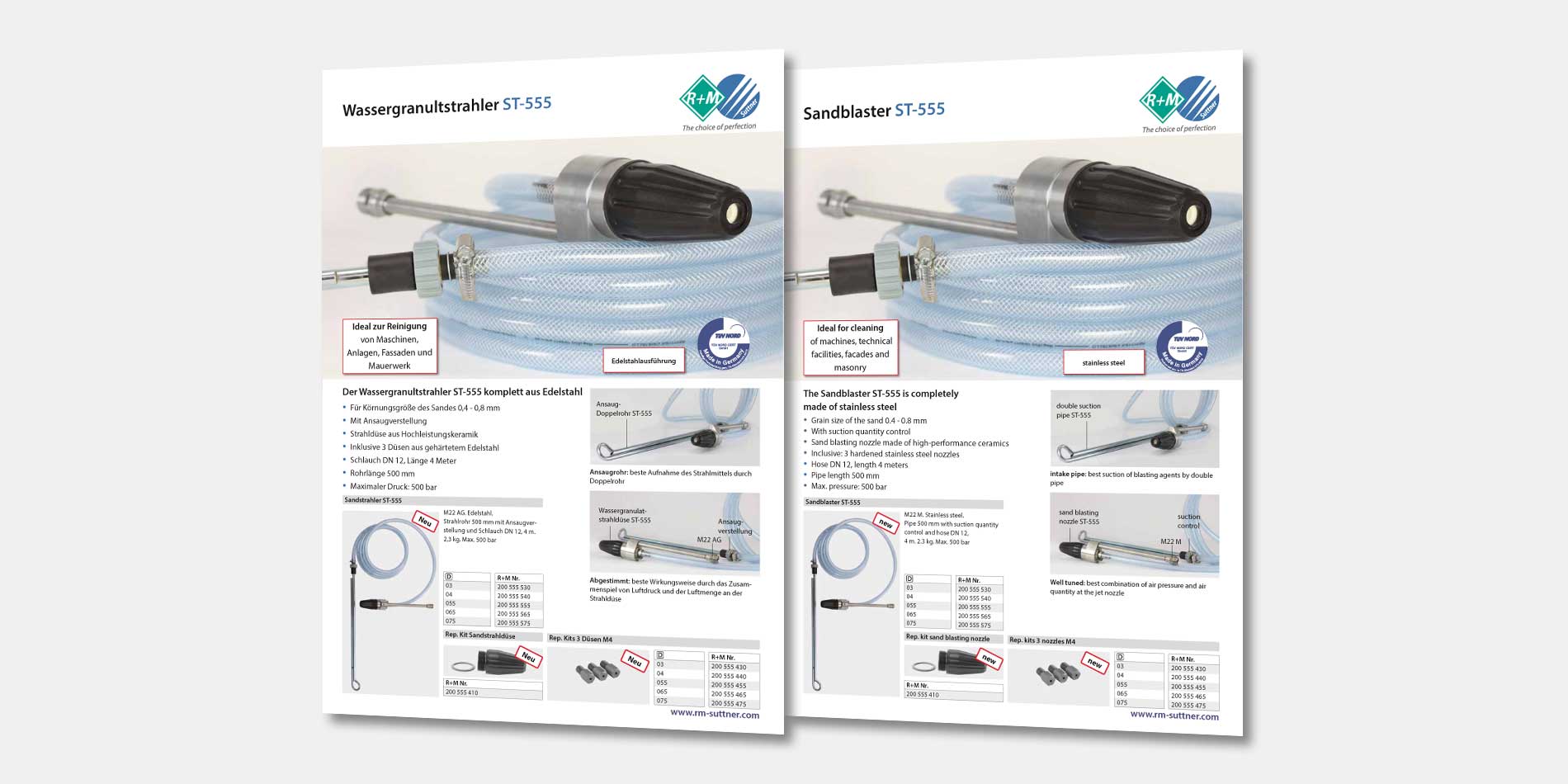
Wet blasting (synonyms: water-granulate blasting, dust-free blasting, slurry blasting) is a hybrid process for surface treatment that combines high-pressure water jetting and abrasive dry blasting. A multi-phase mixture of water, granulate, and air achieves high material removal while simultaneously treating the substrate gently. The water reduces dust generation by up to 92% compared to dry blasting and acts as a dampening medium for the “lapping effect” — a uniform, satin-like surface finish.
Dust reduction: Up to 92% less dust than dry blasting.
Conveying principle: Venturi effect — negative pressure draws granulate from the supply container.
Nozzle material: Silicon carbide or boron carbide (B₄C) for maximum service life.
Occupational safety threshold: From 25 bar operating pressure — eye and face protection mandatory (BGV D15/D26). Quartz content in blasting media: max. 2%.
Max. operating pressure: Up to 500 bar / 50 MPa with stainless steel housings.
Wet blasting, also known as water-granulate blasting, dust-free blasting, or slurry blasting, represents an advanced process for surface treatment that fundamentally differs from traditional dry blasting technology. While conventional dry blasting works exclusively with air and a solid blasting medium, the decisive element of wet blasting is the targeted addition of water to the process. This method combines a high-pressure water jet, a precisely dosed granulate, and air to enable powerful yet controlled cleaning and preparation of surfaces.
Wet blasting is a synergistic hybrid technology that combines the strengths of two established processes: high-pressure water jetting and abrasive blasting. The high kinetic energy of the water jet serves as a carrier and accelerator for the blasting medium, while the water modifies the physical properties of the granulate. The resulting multi-phase flow of solid particles, liquid water, and gaseous air produces unique processing effects that cannot be achieved by either pure water jetting or pure dry blasting alone. The process enables rapid removal of contaminants and old coatings, while the water simultaneously acts as a lubricant and dampens the impact of the blasting medium. This dual function — high impact force combined with gentle substrate treatment — is the key to the superior efficiency and surface quality of the process.
The term “dust-free blasting,” often used synonymously with wet blasting, must be critically evaluated from a physical and technical perspective and can be misleading. While the addition of water significantly suppresses dust emissions — as the water envelope around the granulate particles immediately binds airborne dust and causes it to settle — studies and practical experience show that wet blasting absorbs up to 92% of the dust generated during dry blasting. This leads to a massive reduction in disturbances to the surrounding environment and minimizes health risks from inhaling fine dust particles. However, the process is never entirely dust-free; it always leaves behind moist contaminants and debris on the ground. A comprehensive understanding of the technology therefore requires the recognition that the term “dust-free” is primarily a marketing term that highlights the decisive advantages of the process without implying the physical reality of 100% dust elimination.
The efficient conveyance of the blasting medium into the high-pressure water jet is the heart of the wet blasting process. In most devices, this is achieved through the physical principle of the Venturi effect. This principle, based on Bernoulli’s principle of fluid dynamics, describes how a cross-sectional constriction in the flow path of a fluid increases its velocity. According to the Bernoulli equation, this increase in velocity simultaneously leads to a significant drop in static pressure in the constricted area.
In a wet blasting system, a high-pressure water jet is directed into a Venturi nozzle inside the blasting head. The resulting negative pressure or vacuum at the narrowest cross-section of the nozzle draws the blasting medium through a suction tube from the supply container. In mobile systems that draw blasting media from a barrel, air is additionally mixed in through small holes in the suction tube, which facilitates transport of the granulate in the suction hose and prevents blockages. The amount of blasting medium drawn in can be precisely adjusted. In some devices, this is manually controlled by regulating the so-called “false air supply” via a ball valve. By opening and closing this valve, the operator can adjust the negative pressure and thus the dosage of the granulate in real time, either to aggressively process stubborn materials or to gently clean sensitive surfaces.
The particle dynamics in the wet blasting process are complex and fundamentally different from those in dry blasting. The water acts not only as a carrier medium but also as a lubricant and dampening medium. The “water jacket” surrounding the blasting media particles mitigates the hard, point-like impact on the surface and prevents excessive heat generation through friction. This dampening property leads to a unique “lapping effect.” Rather than merely eroding the substrate at discrete points, the particles glide across the surface in a water envelope, producing a uniform, satin-like or polished finish.
This physical phenomenon explains the apparent contradiction of wet blasting: the high impact energy of the water-granulate mixture enables rapid removal of even stubborn material, while the dampening effect of the water simultaneously ensures gentle processing and a high-quality surface finish. The process optimizes impact energy while minimizing the risk of material deformation that can occur in dry blasting due to excessive friction or particle hammering.
The efficiency of a water-granulate blasting device is largely determined by the design of its blasting head. A central feature for high efficiency and minimized wear is deflection-free guidance of the blasting medium. In this design, the blasting medium is fed into the water jet without any change of direction, typically through three symmetrically arranged high-pressure nozzles.
This special geometry ensures that the impulse energy of the blasting medium is optimally utilized, as no kinetic energy is lost through the impact of abrasive particles on the walls of the blasting head or nozzle. Such a design not only reduces energy loss but also significantly extends the service life of the internal components, as they are not exposed to direct abrasive wear from the granulate.
The longevity of a blasting head is closely linked to the materials science of its critical components, particularly the diffuser nozzle at the outlet. Silicon carbide is known as an extremely hard and wear-resistant material that effectively withstands high abrasion forces.
Even harder materials, such as boron carbide (B₄C), are the hardest materials on the Mohs scale after diamond and cubic boron nitride. Boron carbide nozzles offer an even longer service life, even when using the hardest blasting media such as corundum. The combination of an intelligent design that avoids deflections and the selection of extremely hard, wear-resistant materials such as silicon carbide or boron carbide is crucial for minimizing maintenance costs and maximizing operational efficiency and device lifespan.
The choice of the right blasting medium is critical to the success of a surface treatment project. The Mohs hardness scale serves as an essential guide. A fundamental principle of the technology is that a blasting medium that is softer than the substrate being treated removes contaminants or coatings without damaging the underlying surface. Harder materials, on the other hand, are essential for removing thick layers and processing robust surfaces such as steel or concrete.
The properties and application areas of selected blasting media are explained below:
The choice of blasting medium is a critical compromise between removal efficiency and substrate protection. Reusable media such as glass beads are economically advantageous as they can be used multiple times, while single-use media such as slag and sand break into particles too small for reuse upon impact.
| Blasting Medium | Mohs | Primary Applications | Specific Advantages | Reuse | Notes |
| Glass beads | 5.5–6 | Polishing, cleaning non-ferrous metals, surface finishing | Iron-free, gentle, satin finish, low dust | Reusable | Chemically neutral, produces lapping effect |
| Glass granulate | 5.5–7 | Roughening, rust removal, paint stripping | Abrasive, angular shape, material-friendly, iron-free | Reusable | Ideal for matting and roughening |
| Slag (fine) | 6–7.5 | Graffiti removal, brick cleaning | Inexpensive, high abrasiveness | Single-use | May contain iron; check for rust susceptibility |
| Slag (coarse) | 6–7.5 | Rust removal, concrete rehabilitation | Aggressive removal, ideal for thick coatings | Single-use | Low effort in processing, cost-effective |
| Sodium carbonate | 2.5 | Cleaning sensitive surfaces (aluminum, glass), paint stripping | Water-soluble, very soft, protects substrate | Single-use | Must be fully removed; can cause oxidation |
| Mineral media (sand) | 5–8 | Rust and paint removal, concrete rehabilitation | Versatile, effective on stubborn contaminants | Single-use | Quartz content must be < 2% (health hazard) |
The choice between wet and dry blasting depends on the specific requirements of each project. Each method offers specific advantages and disadvantages that must be carefully weighed.
The most significant strength of wet blasting is the massive reduction in dust generation. The water effectively binds airborne particles, minimizing respiratory stress and making the process preferred in populated or sensitive environments. Furthermore, the water prevents excessive friction, which minimizes heat generation and the risk of deformation in thin metal sheets. The versatility of the process is underscored by the ability to add additives such as rust inhibitors to the water to prevent corrosion after processing.
However, wet blasting also has disadvantages. The treated surfaces remain wet and must be dried before further processing, such as painting or coating. The resulting moist blasting debris is more difficult to handle and dispose of than dry dust. This requires special, liquid-tight containers. Additionally, the visual assessment of the blasting result on the wet surface can be impaired, which may hinder precise quality control during the process.
Dry blasting offers the advantage that treated surfaces can be further processed immediately, as no drying time is required. The used blasting medium lies loose on the ground after the process and is thus easier to dispose of or reuse. Visual assessment of the result is also more precise on a dry surface.
The main disadvantages of dry blasting are the massive dust generation and the associated health risks for operators and the surrounding environment. The process typically requires a special permit and elaborate protective measures for dust control. Another problem is the risk of metal warping. Contrary to the assumption that warping is primarily caused by frictional heat, technical analyses demonstrate that it is mainly attributable to the penetration and hammering of blasting media grains into the surface. This effect, which leads to permanent mechanical deformation of the surface, occurs in both wet and dry blasting. To avoid this, using a blasting medium that is softer than the metal being processed is the only effective solution.
The operation of blasting equipment is subject to strict regulations for the protection of operators and the environment. According to accident prevention regulations (e.g., BGV D15 and D26), adequate eye and face protection is mandatory from an operating pressure of 25 bar. Important legal provisions include the prohibition of silicogenic blasting media with a quartz content exceeding 2%. The use of such materials is only permitted under the strictest conditions. Furthermore, hand-held compressed air blasting devices must be equipped with a dead man’s switch that immediately stops the discharge of blasting media and compressed air when the operator releases it.
Personal protective equipment must be adapted to the specific hazards. For blasting work involving only dust exposure, wearing a blasting helmet with impact protection and fresh air supply is mandatory. When hazardous or toxic substances may be released, additionally ventilated combination protective suits Type 3 according to DIN EN ISO 14877 are required. Persons present in the hazard area — for example, for debris removal — must also wear respiratory protection and protective clothing. Work clothing and personal clothing must be stored separately to prevent contamination.
A critical aspect often underestimated in wet blasting is the disposal of blasting debris. This consists of the blasting medium and the contaminants and coatings removed from the surface. A blasting medium considered environmentally friendly in its original state can become hazardous waste after application if it removes pollutants such as heavy metals, oils, greases, or polychlorinated biphenyls (PCBs) from the processed surface.
The blasting debris is classified as waste or, in the case of contamination, as hazardous waste. Disposal must take place at licensed landfills, the landfill class (DK I, DK II, DK III) depending on the degree and type of contamination. It is the responsibility of the generator to dispose of the waste in accordance with applicable regulations. Contracts between clients and blasting companies must therefore clearly define responsibilities for the disposal of blasting debris and account for the costs of proper disposal in the calculations.
The wet blasting process shifts the problem of fine dust from the air to the disposal of liquid or sludge-like waste. The collection and provision of moist blasting debris must be carried out in suitable, liquid-tight containers to prevent contamination of soils and waterways.
High-quality wet blasting equipment is characterized by its robustness and versatility. Their stainless steel housings are designed for continuous operation at pressures of up to 500 bar / 50 MPa, enabling demanding removal and cleaning tasks. Stepless dosing of the blasting media volume is achieved via an adjustable double suction tube, allowing sensitive adjustment to different surface structures. The efficiency of the system also depends on the optimal matching of nozzle size to the high-pressure cleaner’s performance and the sensitivity of the substrate.
The maximum hose length for the blasting medium is limited to avoid significant performance losses. At a standard length of 4 m, the hose can be extended up to 10 m without major performance losses, provided that a height difference of no more than 2 m is maintained.
A crucial detail ensuring the reliability of the entire system is the blasting head design that effectively prevents backflow of water into the blasting media hose. Without this special geometry in the blasting head, hygroscopic blasting media (e.g., sodium carbonate) could absorb water, clump, and block the system, leading to malfunctions.
For safe and efficient storage and handling of blasting granulate, special blasting media barrels with integrated suction are recommended. These containers enable mobile working, protect the blasting medium from rain and moisture, and simplify dosing through the integrated suction device. Operation absolutely requires the use of dry blasting media, as moist granulate can lead to blockages and malfunctions.
The water-granulate blasting process is a highly developed, modern technology for surface treatment that synergistically combines the advantages of high-pressure water jetting and abrasive blasting. Its primary benefits lie in the massive reduction of dust generation, the minimized thermal and mechanical stress on the substrate, and superior process speed.
The high efficiency and longevity of the equipment are ensured by innovative, deflection-free blasting head designs and the use of wear-resistant materials such as silicon carbide or boron carbide. The flexibility of the system, guaranteed by stepless blasting media dosing and a choice of numerous specialized granulates, enables precise adaptation to virtually any substrate.
Although wet blasting offers considerable advantages over traditional dry blasting technology, its application requires a comprehensive understanding of the physical principles, careful selection of materials, and compliance with strict safety and disposal regulations. The challenges of handling moist blasting debris and its potential contamination must be considered from the outset in project planning.
The development of such hybrid technologies that integrate efficiency, safety, and environmental considerations represents a decisive step forward in surface treatment. The future lies in systems that not only ensure effective cleaning but also minimize environmental impact and prioritize operator health.
Wet blasting is a hybrid process that combines high-pressure water with a dosed granulate. A high-pressure water jet draws granulate from a container via the Venturi effect and accelerates it onto the surface being treated. The water dampens the impact (“lapping effect”), reduces dust by up to 92%, and prevents excessive heat generation — while maintaining high removal capacity.
No — “dust-free blasting” is primarily a marketing term. The water demonstrably reduces dust emissions by up to 92% compared to dry blasting by immediately binding airborne particles and causing them to settle. However, the process is not entirely dust-free: it always leaves behind moist contaminants on the ground that must be disposed of as sludge.
Wet blasting: Massive dust reduction (up to 92%), gentler due to the dampening water jacket (“lapping effect”), treated surfaces must be dried, moist debris more difficult to dispose of. Dry blasting: Immediately processable (no drying), simpler disposal of granulate, but extreme dust generation with health risks and permit requirements. The choice depends on the substrate, environment, and requirements for surface quality.
Glass beads (Mohs 5.5–6): Polishing, cleaning copper/bronze, matting stainless steel — gentle, iron-free. Glass granulate (Mohs 5.5–7): Roughening, rust removal, paint stripping — more abrasive, angular. Slag (Mohs 6–7.5): Graffiti removal, rust, thick coatings — inexpensive, single-use, may contain iron. Sodium carbonate (Mohs 2.5): Sensitive surfaces (aluminum, glass, plastic) — water-soluble, remove residues completely. Quartz sand: Only under strict conditions, as quartz content > 2% is prohibited (silicosis risk).
Wet blasting debris (a mixture of granulate and removed contaminants) is classified as waste or — if contaminated with heavy metals, oils, or PCBs — as hazardous waste. Disposal at licensed landfills (Class DK I, II, or III depending on contamination level) in liquid-tight containers. Disposal responsibility lies with the generator and must be clearly regulated by contract.
From 25 bar: Eye and face protection mandatory (BGV D15, D26). For dust exposure: Blasting helmet with impact protection and fresh air supply. For hazardous substances: Combination protective suit Type 3 (DIN EN ISO 14877). Equipment requires a dead man’s switch. Work clothing and personal clothing must be stored separately (contamination prevention).
Metal warping is primarily caused by the hammering of blasting media grains into the surface (mechanical deformation), not primarily by heat. In wet blasting, the water jacket around the particles mitigates the impact and prevents deep penetration into the substrate. This protects thin metal sheets from plastic deformation. The only effective counterstrategy for both methods: choose a blasting medium that is softer than the substrate.